


When an anonymous TikTok account sends the Republic searching for chefs, waitresses, customers — and perhaps eventually the tomato.
Once upon a time, in the Republic of Uncommon Sense, the police went looking for the person who cooked Ghana Jollof.
Not the rice.
Please.
For years, Ghanaians and Nigerians have fought over jollof with the seriousness of countries negotiating disputed territory. Friendships have been tested. National pride has been wounded. Nigerians have produced photographic evidence. Ghanaians have rejected it without reading.
But now Ghana has introduced an entirely new jollof competition:
Who actually cooked it?
This particular Ghana Jollof lives on TikTok.
No rice. No onions. No tomatoes.
Just politics, insults, accusations and enough pepper to cause discomfort at some very high tables.
The cook remained anonymous.
Then the State entered the restaurant.
THE MYSTERIOUS KITCHEN
Senior Nursing Officer Salomey Awity Baffoe was arrested over alleged links to the Ghana Jollof TikTok account and subsequently remanded for two weeks by an Adenta Circuit Court while investigations continued.
Her lawyer questioned the basis for keeping her in custody, saying authorities had themselves indicated that the person behind Ghana Jollof was in the United Kingdom.
Then another plate arrived.
On September 17, the Ghana Police Service declared 40-year-old Barbara Asantewaa Kodua wanted in connection with an alleged case of inciting violence and publicly associated her with Ghana Jollof. Police said they had information suggesting she might be in the United Kingdom. The wanted notice did not provide further details about the particular statements or conduct said to constitute the alleged incitement.
At this point even the restaurant menu required legal representation.
Was Salomey the cook?
Was Barbara the chef?
Was one supplying tomatoes?
Was somebody merely carrying takeaway?
Or have we reached that exciting stage of Ghanaian politics where walking past the restaurant while jollof is cooking requires you to travel with a lawyer?
These questions would merely be hilarious if they were not sitting inside a much bigger and more serious national argument.
WHEN SPEECH BECOMES A POLICE MATTER


Increasingly, civil-society voices are asking whether Ghana is becoming too comfortable with arrests arising from speech.
The Media Foundation for West Africa says it documented 14 arrests linked to false-news and offensive-speech laws within the first 16 months of the current NDC administration, compared with eight during the entire eight years of the previous NPP government.
The MFWA describes the pattern as a disturbing criminalisation of speech and has criticised what it considers the disproportionate use of provisions including Section 208 of the Criminal Offences Act and Section 76 of the Electronic Communications Act.
Now this is where the jollof becomes particularly spicy.
The MFWA recalls that while in opposition, John Mahama himself complained about the “growing criminalisation of speech and journalism in Ghana.”
Politics is truly a miraculous profession.
Some principles apparently behave like Ghanaian politicians during election season: highly visible before victory, occasionally difficult to locate after inauguration.
The opposition politician sees the police van approaching and immediately spots tyranny.
Give him the keys to government and, mysteriously, the same van begins to look like law enforcement.
Power performs eye surgery without anaesthesia.
FREEDOM OF SPEECH IS NOT FREEDOM TO THREATEN
But let us also be fair.
Freedom of expression cannot mean that every citizen with a smartphone and cheap data automatically becomes Minister for Abuse.
If somebody genuinely threatens another person, incites violence or commits an offence recognised by Ghanaian law, the State has a legitimate responsibility to investigate.
Investigate.
Charge the person where the evidence supports a charge.
Produce the evidence.
Allow counsel.
Let the courts decide.
The argument for free speech is not an argument for a national insult festival.
But democracy places obligations on both sides.
Citizens must exercise their freedom responsibly.
And governments — especially presidents, ministers and other powerful officials — must develop considerably thicker skins than ordinary mortals.
Otherwise every outrageous TikTok video will cause the machinery of State to start warming its engines.
THE QUESTIONS THAT WILL NOT GO AWAY
The Ghana Bar Association has now added its voice to concerns surrounding arrests of social-media commentators, stressing that suspects’ constitutional rights must be respected and that bail conditions should be reasonable, proportionate and consistent with the presumption of innocence.
The government rejects the suggestion that it has a policy of suppressing free expression.
On September 17, Government Communications Minister Felix Kwakye Ofosu said the administration does not condone the harassment or intimidation of journalists and regards the media as an important partner in accountability and national development.
Fair enough.
But reassurance is strongest when accompanied by clarity.
What exactly did Ghana Jollof say that constitutes the alleged incitement?
Which specific offence is alleged?
Who is alleged to have committed it?
What evidence connects the various people being investigated to that offence?
And, perhaps most importantly, are investigative powers being exercised proportionately?
These are not NDC questions.
They are not NPP questions.
They are democratic questions.
Because governments change.
The opposition of today becomes the government of tomorrow, and the government of today eventually rediscovers the comforts of opposition.
Then something miraculous happens.
The politician who defended strong police action yesterday suddenly develops an extraordinary interest in civil liberties.
Yesterday’s freedom fighter discovers Section 208.
Yesterday’s government spokesperson discovers human rights.
The chairs change.
The speeches change.
The police station remains exactly where it was.
DEMOCRACY MUST SURVIVE BAD MANNERS
One of democracy’s least attractive features is that it protects the right of people to say things we may consider foolish, insulting, irritating or downright offensive.
That is precisely why freedom of expression matters.
Nobody needs constitutional protection to praise the President.
You do not require Article 21 to announce that the government is doing wonderfully.
Trouble begins when the speech becomes uncomfortable.
That is when a Republic discovers whether its commitment to free expression is a principle or merely a campaign slogan.
The State has every right to pursue genuine criminal conduct.
But criticism, mockery and even appalling political manners should not casually be bundled into the same takeaway pack as criminal incitement.
The distinction matters.
Because when citizens begin wondering whether criticism might bring police attention, silence can become the safest political opinion.
And a democracy in which citizens are free to speak only when government likes what they are saying is not particularly free.
It is merely well behaved.
SO, WHO COOKED IT?
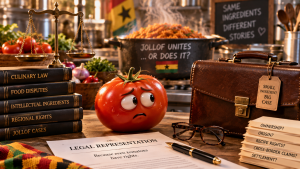
Which brings us back to the restaurant.
For once, Nigerians can relax.
Nobody is presently asking whether Ghana Jollof tastes better than Nigerian Jollof.
Our problem is considerably more fundamental.
Who cooked it?
And before we arrest the waitress, remand somebody who knows the restaurant, question the customer and issue an international notice for the chef, perhaps the Republic should first explain clearly what exactly was discovered inside the pot.
If an offence was cooked there, identify it.
If there is evidence, serve it.
If there are suspects, connect them to the kitchen.
But let us resist turning every irritating political voice into a national-security cooking competition.
Otherwise, at the rate we are going, the only person who has not yet been invited to assist investigations…
is the tomato.
And even the tomato should probably keep its lawyer’s number nearby.