






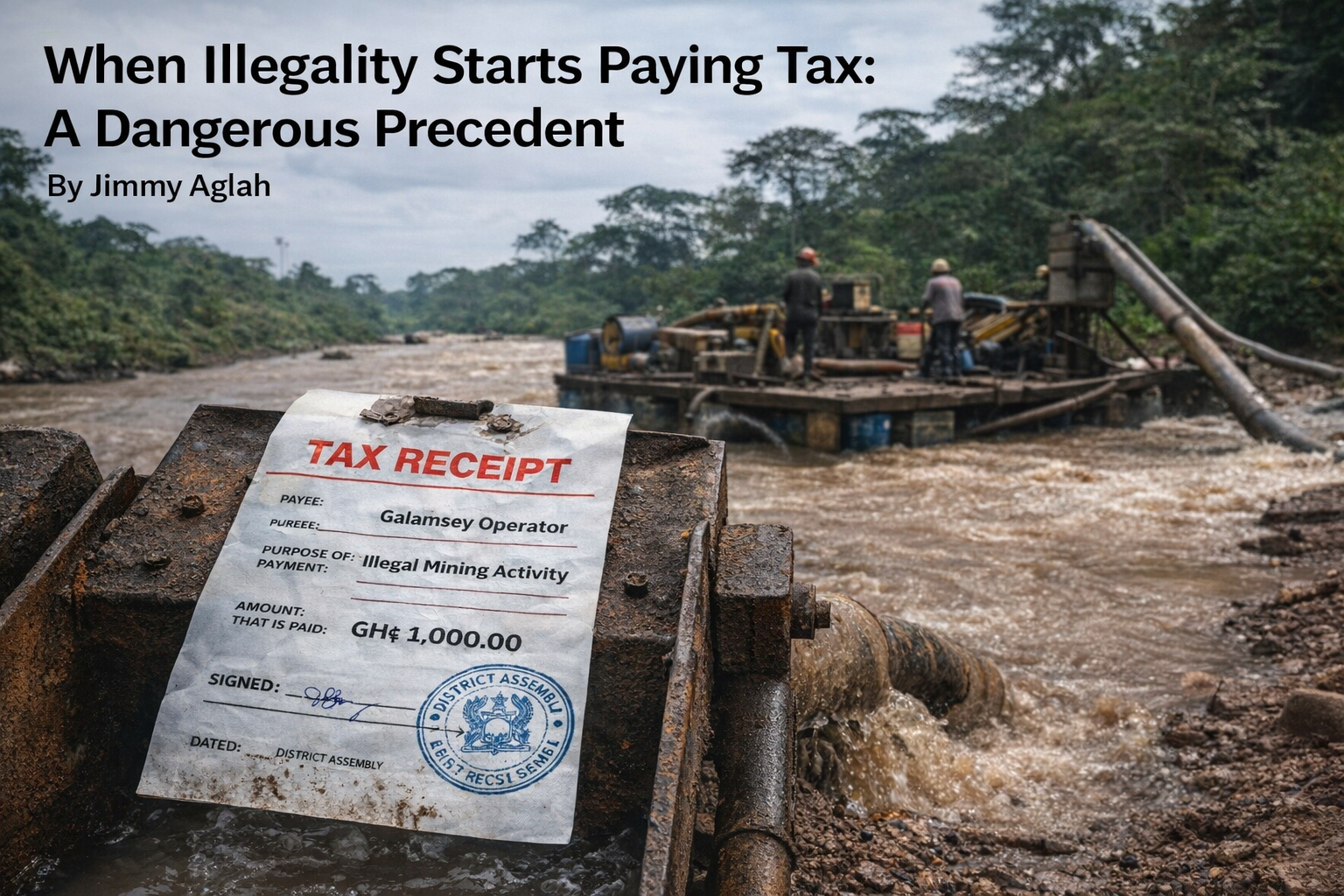
When Illegality Starts Paying Tax: A Dangerous Precedent
By Jimmy Aglah
Illegal mining tax Ghana is now at the center of a national debate about governance, environmental protection, and the rule of law.
The illegal mining tax Ghana issue is no longer just a local governance concern. It has become a national credibility test.
When a state begins to derive revenue from what it is supposed to eliminate, the problem is no longer just illegality. It is moral confusion dressed up as local governance.
Recent developments following a JoyNews investigation into illegal mining activities have raised serious concerns about governance, environmental protection, and the rule of law. The exposé revealed that in some mining communities, operators of changfan machines, widely associated with illegal river mining, were not only active but allegedly making payments to local authorities.
These payments, reportedly collected by some District Chief Executives, were explained as contributions toward Internally Generated Funds (IGF). That explanation did not calm public concern. It deepened it.
Because once illegality starts paying tax, the country has wandered into very dangerous territory.
Illegal Mining Tax Ghana Debate Explained
At the heart of this issue is one uncomfortable question: can an illegal activity be legitimised through taxation?
Under Ghanaian law, illegal mining is illegal. That should be the easiest sentence in the country to understand. River-based operations involving changfan machines are prohibited. District assemblies do not have the legal mandate to impose taxes on activities that are unlawful in the first place. Any such collection therefore sits outside the normal framework of lawful revenue mobilisation.
The illegal mining tax Ghana controversy raises deeper institutional questions about accountability, public ethics, and whether institutions charged with protecting communities are instead learning to profit from their destruction.
The JoyNews Exposé and the Changfan Controversy
The JoyNews report did more than expose a local practice. It forced a national conversation.
It showed polluted rivers, active illegal mining operations, and the apparent normalization of a system in which operators of destructive equipment were allegedly making payments while continuing their work. In plain language, the impression created was simple and troubling: if the machines were paying, then someone in authority had found a way to live with the illegality rather than stop it.
And that is where public outrage came from.
Ghanaians have watched river bodies turn brown, farms become vulnerable, and communities lose access to clean water. The national anti-galamsey conversation has always been emotionally charged because it is not abstract. It touches drinking water, food systems, livelihoods, and the future of public health. So when the public hears that illegal operators may be contributing financially to district-level revenue, the natural reaction is not admiration for local creativity. It is alarm.
Why the Environmental Stakes Are Too High
First, there is the question of environmental sustainability.
Ghana’s major rivers, including the Pra, Ankobra, and Offin, have already suffered severe degradation from illegal mining. The continued use of changfan machines on water bodies accelerates that destruction. Sedimentation, mercury contamination, destruction of aquatic ecosystems, and the loss of potable water sources are not theoretical concerns. They are present realities.
Every day such activity is tolerated, the cost multiplies.
Water treatment becomes more expensive. Farming becomes more fragile. Public health risks intensify. The burden is passed to ordinary citizens while the short-term gains are enjoyed by a few. No district assembly struggling for revenue should convince itself that this is development. It is the accounting version of selling the roof to buy paint.
Critics argue that the illegal mining tax Ghana approach risks normalising environmental destruction under the guise of revenue generation.
When Revenue Collection Undermines the Rule of Law
Second, there is a governance issue that cannot be brushed aside.
District Chief Executives are not private brokers operating from a kiosk behind the lorry station. They are representatives of state authority. Their actions carry symbolic and political weight. If they are perceived to be collecting money from illegal operators, then the public is entitled to ask a very direct question: is the state fighting illegality, or merely supervising it?
That perception alone is damaging.
Even if the intention was to raise funds for local development, the method sends the wrong signal. It creates the impression that the law is negotiable, that illegality can be managed so long as it contributes something to the local purse, and that environmental destruction may be tolerated if it arrives with a receipt.
That is not public administration. That is moral hazard with official letterhead.
Why Civil Society Pushed Back
It is therefore no surprise that civil society organisations, including A Rocha Ghana and IMANI Africa, strongly pushed back against the development. Their position is rooted in a principle that should not require a national debate: an illegal act cannot be regularised through informal taxation.
Once the state or its agents begin to derive income from a prohibited activity, the incentive to eliminate that activity begins to weaken. Enforcement becomes conflicted. Public messaging becomes inconsistent. Trust erodes. And citizens begin to wonder whether the fight against galamsey is a policy commitment or merely a slogan that depends on who is collecting what.
That is why the backlash was sharp. The concern was not only about the legal technicality of tax collection. It was about the dangerous precedent it creates.
The President, the CSOs, and the Bigger Policy Test
The subsequent engagement between the President and civil society groups provided some clarification, with renewed emphasis on the government’s commitment to fighting illegal mining. That was necessary. But clarification alone cannot fully resolve the deeper issue.
Public perception has already been shaped by the initial interpretation of events. And in matters like this, perception matters because it affects confidence in the sincerity and coherence of state action.
This is now a broader policy test.
If Ghana is serious about confronting illegal mining, then enforcement must be consistent, transparent, and uncompromising. There cannot be one message for press conferences and another for revenue collection at the district level. There cannot be a war on galamsey in speeches and a payment window for its machinery in practice.
The anti-galamsey fight will not be won by rhetoric alone. It will be won when every level of the state behaves as though illegality is a threat to be eliminated, not an inconvenience to be monetised.
When Illegality Starts Paying Tax, Everyone Should Worry
The question is not whether districts need revenue. They do.
The question is whether revenue can be pursued at the expense of legality, environmental protection, and public credibility.
At the heart of the illegal mining tax Ghana debate is a conflict between revenue and legality.
If the illegal mining tax Ghana model is allowed to stand, it may quietly redefine how illegality is treated in public policy.
Because once illegality becomes a source of income, the incentive to eliminate it begins to diminish. And when that happens, the law does not merely weaken. It begins to change character.
That is the real danger here.
Not just polluted rivers. Not just muddied governance. But a national culture in which the line between enforcement and complicity starts to fade.
And that is a risk Ghana cannot afford.
Global Context and Why It Matters
This is not a Ghana-only problem. According to the World Bank, weak regulation of extractive activities can severely damage water systems, local livelihoods, and institutional credibility. That is why the illegal mining tax Ghana conversation matters beyond one headline or one district. It is about whether a country can defend its laws while protecting its people and natural resources.
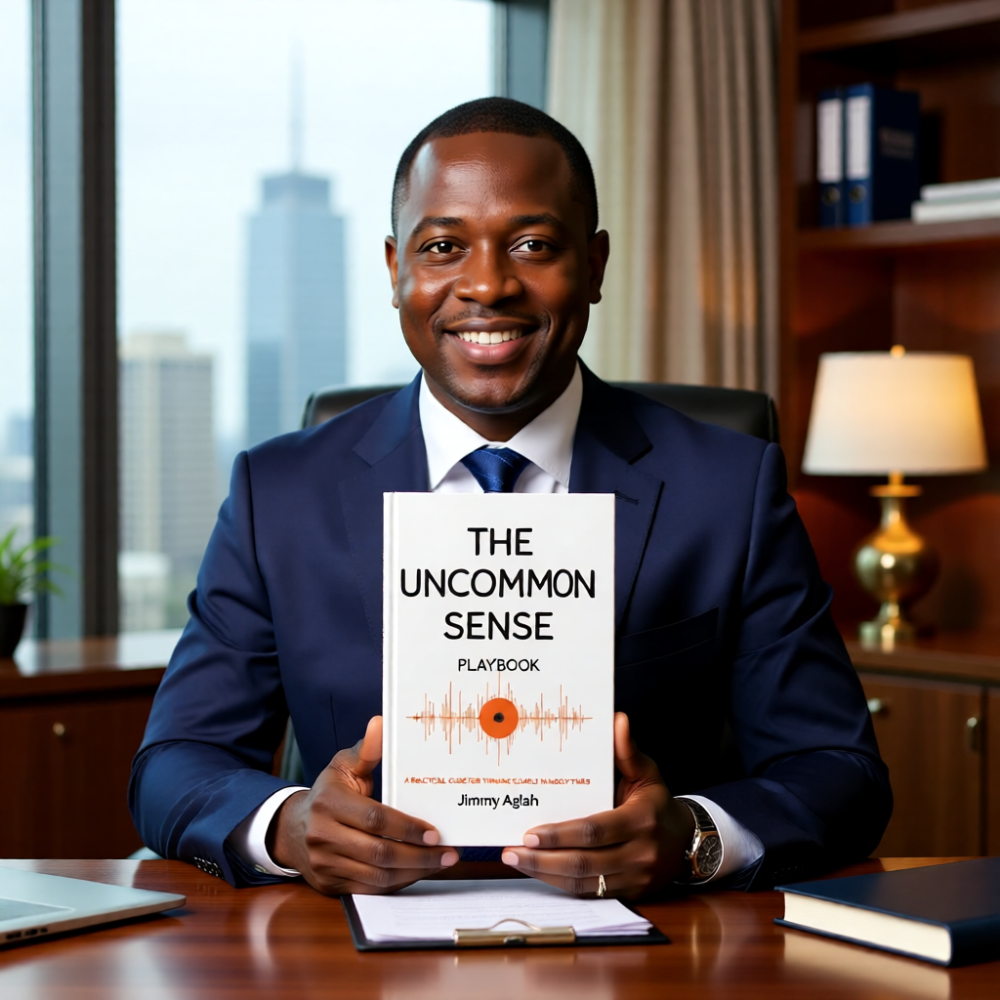
Read Also: The Uncommon Sense Playbook
Thinking Clearly in Noisy Times is a practical and sharp guide for navigating complex public conversations with clarity and reason.
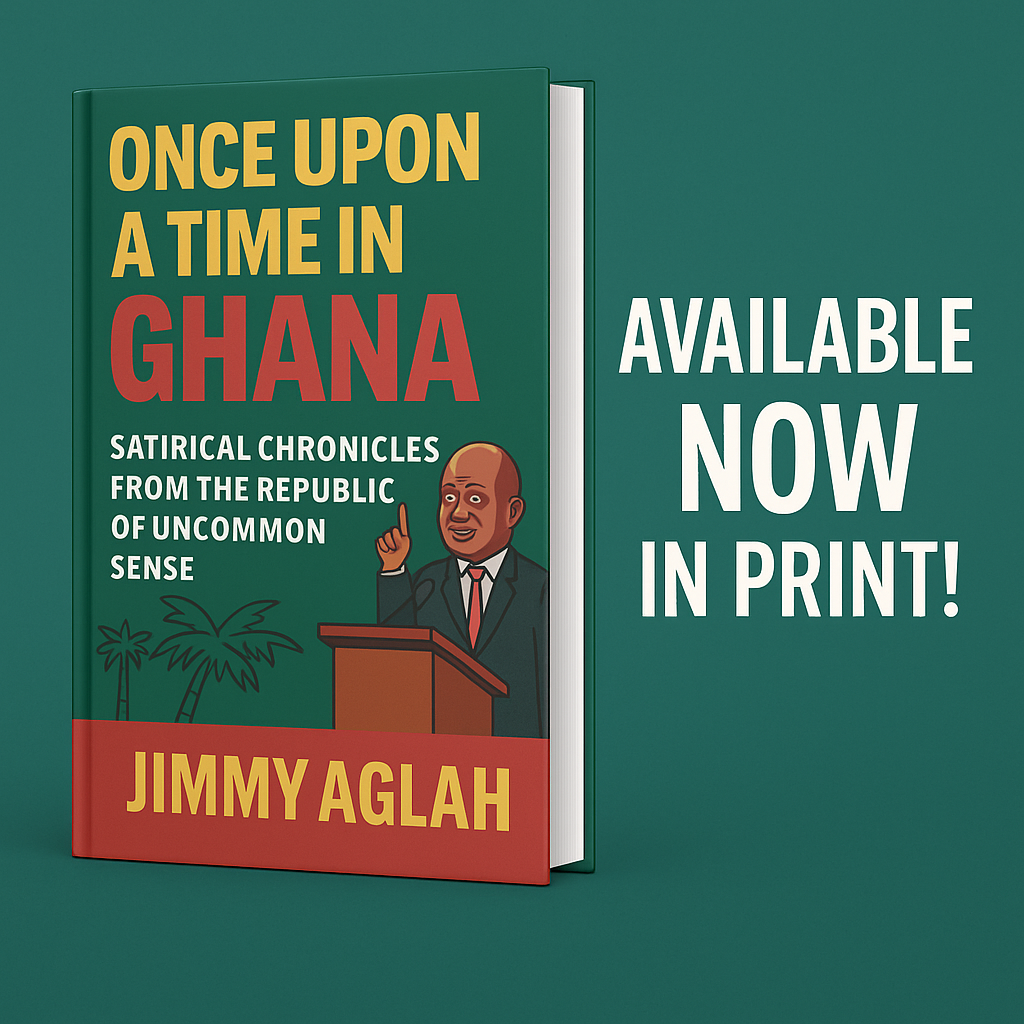
Also by Jimmy Aglah
Once Upon a Time in Ghana delivers witty and satirical reflections on politics, power, and everyday absurdities in the Republic.
Resource Box
Jimmy Aglah is a media executive, broadcaster, and writer based in Kumasi, Ghana. He is the author of Once Upon a Time in Ghana and The Uncommon Sense Playbook. Read more at RepublicOfUncommonSense.com.