







ECG Estimated Billing: When the Light Goes Off but the Bill Stays On
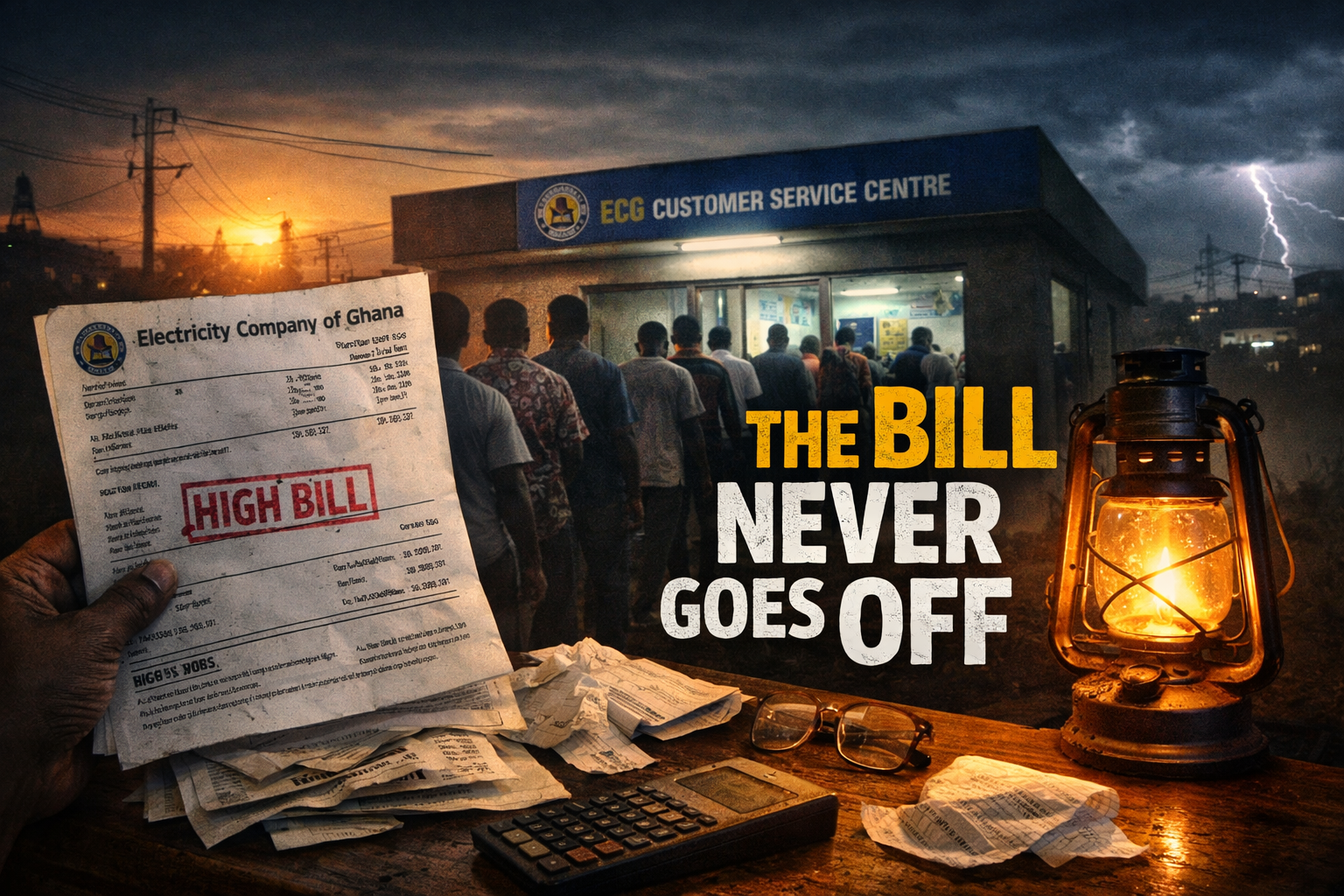
ECG estimated billing has become one of the most quietly frustrating features of life in Ghana, where the light may go off but the bill remains impressively loyal.
Once upon a time in the Republic of Uncommon Sense, electricity behaved like a polite guest.
It came when invited. It left when offended. And most importantly, it billed you according to how long it stayed.
Then one day, electricity developed ambition.
It began to charge for visits it never made.
In one household, a man decided to conduct a small experiment, not in a laboratory, but in his own home.
For three months, the house was practically on sabbatical.
His wife had travelled abroad. His children were tucked away in boarding school. He left home early each morning and returned late each evening, deliberately reducing his electricity usage to the bare minimum.
Lights were used sparingly. Appliances rested like retirees. Even the fridge seemed to be on probation.
The objective was simple: consume less, pay less.
A noble belief.
ECG Estimated Billing and the Curious Science of Sameness
At the end of the first month, the bill arrived.
Unchanged.
The second month came.
Same bill.
By the third month, the man began to suspect that electricity in Ghana had stopped reading meters and started reading minds.
Or worse, ignoring both.
In frustration, he did what many Ghanaians now consider the final act of independence: he installed a solar hybrid system.
Panels went up. Batteries were installed. The sun itself was recruited as an unpaid intern.
Surely now, logic would return.
Surely now, the bill would reduce.
But the Republic had other plans.
The bill continued to arrive, steady, confident, and completely unmoved by the presence of the sun.
At this point, even daylight could not convince the system.
And so, like many citizens before him, he took the matter to the authorities and filed a dispute with the Public Utilities Regulatory Commission.
He is still waiting.
Because in Ghana, justice, like electricity, sometimes comes and goes.
What ECG Estimated Billing Really Feels Like
This is what we are told is estimated billing.
A beautiful phrase.
It suggests science. It sounds like mathematics. It smells like calculation.
But in practice, it behaves like prophecy.
Someone, somewhere, closes their eyes and estimates your suffering.
And the estimate is never shy.
It does not whisper.
It announces itself boldly, like a town crier with a megaphone and no conscience.
Meanwhile, the consumer, armed with nothing but a receipt and rising blood pressure, is invited to lodge a complaint.
You fill a form. You attach evidence. You explain your innocence as though you have been accused of stealing electricity from heaven.
Then you wait.
And while you wait, the bills continue to arrive, each one more confident than the last.
The Trust Problem Behind ECG Estimated Billing
At this point, even your prepaid meter begins to look like a misunderstood hero.
At least prepaid has the decency to insult you in advance.
Postpaid, on the other hand, is like a friend who eats your food quietly and sends you the bill after the party.
But let us not pretend this is merely about billing.
No.
This is about trust.
Because electricity, like leadership, is invisible when it works and unforgettable when it fails.
When a system begins to charge citizens for what they cannot see, cannot verify, and cannot challenge, it stops being a service.
It becomes a mystery.
And Ghanaians, for all our patience, do not enjoy mysteries when they involve our money.
We enjoy mysteries in Nollywood.
Not in our wallets.
And this is where the real comedy begins. In every functioning system, a bill is supposed to explain itself. It should reflect usage, not imagination. It should be measurable, not mystical. But when consumers reduce usage, install solar, monitor appliances, and still receive stubbornly familiar charges, the bill starts to look less like a statement of account and more like a confidence trick dressed in official language. That is the danger. Not just the money lost, but the confidence lost. Because once citizens begin to believe that consumption and payment are no longer related, the entire relationship between provider and public becomes shaky. And when trust goes off, it rarely comes back on by itself.
Until then, citizens will continue to live in a curious arrangement:
Where darkness is real, but the charges are even more real.
And in this Republic, that is what we call power.
Related: More stories from the Republic of Uncommon Sense
External Reference: Public Utilities Regulatory Commission (PURC)