


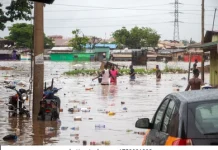
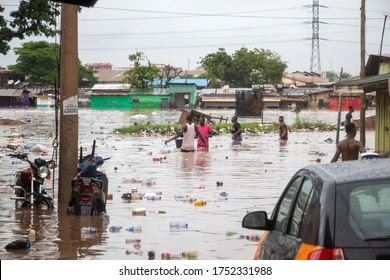
Once upon a time in the Republic of Uncommon Sense, before the Accra floods became an almost familiar national ritual, rain understood boundaries.
Rain fell on roofs and remained outside. People remained indoors. This arrangement was simple, ancient and generally respected by all parties.
The clouds gathered. The wind blew. Mothers rushed outside to rescue clothes from drying lines. Children were summoned indoors with the urgency usually reserved for impending punishment. Windows were closed, and where the roof had acquired one or two unofficial openings, a basin was strategically positioned beneath the leak.
Then the family settled down.
The rain did its work outside, while the home did its work inside. For generations, this understanding served the Republic reasonably well.
In recent years, however, rain appears to have reviewed the agreement.
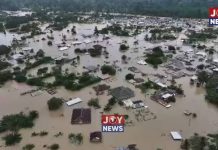
In parts of the Republic, particularly its great capital city, water is no longer satisfied with falling from the sky and passing through drains. It has developed social ambitions. It visits homes, enters living rooms without knocking, inspects bedrooms, opens refrigerators and lifts plastic chairs onto voyages for which their manufacturers never designed them.
Sometimes it spends the night.
It was against this background that the recent advice attributed to the Minister for the Interior, asking people to stay at home during floods, caught my attention.
The advice itself is perfectly sensible. When roads are flooded, people should avoid unnecessary travel. Vehicles can be swept away, open drains become invisible and a familiar road can suddenly acquire the characteristics of the Volta River. Staying indoors can save lives.
The difficulty is that the advice assumes that the home itself is not participating in the flood.
For many residents of our cities, this assumption is becoming increasingly optimistic.
Which home exactly should they stay in?
The house where water is rising towards the windows? The room whose occupants have already moved onto tables? The compound where the television is floating past the refrigerator? Or the wooden structure that has quietly abandoned its former duties as a house and begun training for Noah’s Ark?
These are not merely philosophical questions. For thousands of urban residents, the flood does not happen somewhere outside the home. The flood comes inside, settles down and behaves as if it has paid advance rent.
There is an old Ghanaian wisdom that the person sitting by the fire does not understand the suffering of the one carrying firewood through the rain. It is easy to give perfectly sensible advice from a dry office. The difficulty begins when the citizen receiving the advice is standing ankle-deep in water in his own bedroom, holding a television set above his head and wondering whether government instructions permit him to evacuate through the window.
A home is supposed to be the last place to which a person retreats when the outside world becomes dangerous. When there is violence, we say, “Go home.” When there is a storm, we say, “Stay indoors.” When there is danger, the home is assumed to be the final fortress.
But what happens when the fortress begins floating?
Perhaps we have reached the point where every flood advisory must come with a small questionnaire.
The first question would establish whether the citizen has a home. The second would determine whether the home is still stationary. The third would confirm whether the furniture is still obeying gravity. Only after these preliminary checks should the citizen be formally advised to stay at home.
Everyone else may report to the nearest branch of the Ministry of Staying at Home.
This new ministry would immediately become one of the busiest institutions in the Republic. It would require a Directorate of Dry Floors, a Bureau of Floating Mattresses, a Department of Missing Roofs and an Office of Relocated Chickens. There would also have to be a Maritime Division for wooden structures that have suddenly developed ambitions to become Noah’s Ark.
The comparison with Noah is, of course, slightly unfair to our citizens. Noah received advance warning, detailed construction instructions and enough time to prepare. The modern urban resident often receives a WhatsApp video after the water has already entered the kitchen, by which time the chickens have made their own arrangements.
The Accra Floods and Our Familiar National Ritual
Every episode of the Accra floods seems to follow a familiar national script. The clouds gather, the rain falls and the roads begin disappearing. Soon, social media assumes command of the emergency.
A taxi driver approaches a flooded road and studies the water carefully. People on the roadside shout warnings. He considers their advice, looks again at the water and, for reasons known only to himself and his ancestors, decides that his Toyota Corolla has been hiding amphibious capabilities from him.
He enters the water.
Halfway through, the engine remembers that it is a car.
Young men rush into the water to push it out while the owner sits behind the steering wheel looking betrayed by Japanese engineering.
Elsewhere, a refrigerator floats past a doorway. A mattress is carried above somebody’s head. A woman screams while a man nearby records everything on his phone. Somebody asks where NADMO is. Somebody blames the government. Somebody blames citizens for throwing rubbish into drains. Somebody blames buildings on waterways.
Eventually, a politician arrives in Wellington boots.
This is an important part of the ceremony.
In Ghanaian public life, Wellington boots are the official national costume of concern. Once an official wears them and walks carefully through brown water while cameras follow, we know that the matter has reached the highest level of attention.
Promises follow. The drains will be cleared, buildings on waterways will be removed, and the flooding problem will be solved once and for all.
Then the rain stops, the water recedes, the cameras leave, the Wellington boots return to storage, and the country waits for the next rainy season.
We have become remarkably efficient at discussing floods after they happen. Our vocabulary is excellent. We know about desilting, dredging, drainage capacity, buffer zones, building permits, wetlands, climate change and indiscriminate waste disposal. Indeed, if vocabulary could carry water, Accra would be one of the driest cities in Africa.
Yet the floods keep returning.
Part of the problem is that our flood conversations are often too convenient. The easiest explanation is that people have built in waterways. Certainly, some have, and planning regulations must be enforced. Waterways must be protected and dangerous structures removed where necessary.
But cities do not become flood-prone through the misconduct of poor residents alone.
Drainage systems become inadequate, maintenance is neglected and development outruns infrastructure. Wetlands disappear, waste management systems struggle, planning regulations are enforced selectively, and new communities emerge faster than roads and drains can follow them.
Sometimes, too, buildings appear in places where no sensible planner would expect to find them.
Ask who gave the permit and everybody suddenly develops memory problems.
The assembly cannot remember. The planning officer has been transferred. The developer has documents. The documents have signatures, but the signatures belong to people who are no longer available.
Meanwhile, the building stands confidently in the path of water.
The elders say that when the frog comes out of the water to announce that the crocodile is sick, one does not argue with it. Water is the oldest resident of every waterway. It remembers where it used to pass, even when human beings have forgotten. We may rename the area, sell plots, issue permits, build walls and commission estates, but when the rains become heavy enough, water occasionally returns to inspect its ancestral property.
And water is a very difficult litigant. It does not go to court.
A recent Ghana Statistical Service report indicated that about 4.8 million people, representing roughly 30.8 per cent of Ghana’s urban population, live in slum conditions.
Thirty point eight per cent is a number, and numbers are very well behaved. They do not cry, carry wet mattresses or stand in brown water looking at destroyed schoolbooks. They do not calculate how many years of trading income have disappeared from a flooded shop.
But behind every percentage is a human being, a family and an address.
And sometimes the flood knows the address.
For a person with sufficient income, the advice to relocate from a flood-prone area may sound perfectly reasonable. But for the poor, relocation is not merely a decision. It is an invoice.
A trader may know that her room floods during heavy rain. A security guard may know that the drainage system near his home is inadequate. A casual worker may know perfectly well that his family lives dangerously close to a waterway.
Knowledge does not automatically produce rent.
This is one of the cruellest realities of poverty: people can be fully aware of the dangers around them and still lack the financial power to escape them.
That is why flooding cannot be discussed only as a drainage problem. It is connected to housing, urban planning, sanitation, poverty and, ultimately, governance. These issues overlap in ways that become painfully visible whenever the rain falls.
The poor are frequently advised to make better choices by people who have more choices. They are told to move to safer neighbourhoods, rent better houses and avoid flood-prone areas. All of this is excellent advice, except for one small administrative detail: the money required to obey it.
Perhaps that too can be supplied by the Ministry of Staying at Home.
There is another uncomfortable matter. We tend to measure disaster response by what we can see. Rescue boats arrive and we say the authorities are working. Officials appear in raincoats, excavators begin clearing debris, and television cameras record evidence that something is being done.
Yet the most successful disaster management is often invisible. A drain that works attracts no television cameras. A building permit correctly denied does not trend on social media. Nobody holds a press conference to celebrate a wetland that was simply left alone, and a family relocated before disaster strikes never appears in the evening news being rescued from a rooftop.
Prevention, unfortunately, is a terrible politician. It has no dramatic photographs, makes no emotional speeches and rarely gets invited to commissioning ceremonies. Yet it is often the difference between rainfall and tragedy.
The challenge before our leaders, planners and city authorities is therefore larger than issuing emergency warnings when the clouds have already gathered. Warnings are necessary and citizens must take them seriously, but those warnings must be connected to the realities of the people receiving them.
If residents are told to leave unsafe homes, where should they go? Where are the clearly identified temporary shelters? What community-level systems activate before the water rises? Who checks on elderly residents, children and persons with disabilities? How quickly do warnings reach the most vulnerable communities?
More importantly, what serious work is being done between one rainy season and the next to ensure that fewer people require rescue in the first place?
These are not glamorous questions, but water has little respect for glamour. It follows gravity, finds the lowest places, enters the gaps left by poor planning and remembers waterways that human beings have forgotten.
Perhaps that is why floods are such ruthless auditors of cities.
A city may produce beautiful planning documents, organise conferences, launch resilience strategies, commission studies and hold stakeholder consultations in air-conditioned hotels.
Then the rain falls.
Within hours, the water produces its own report. Its report has no executive summary and no PowerPoint presentation. It simply presents the evidence.
The recent Accra floods should therefore force us to reconsider not merely how we respond to heavy rain, but what kind of cities we are building and for whom. They also raise a larger national question about the distance between Ghana’s enormous potential and the everyday evidence of progress.
A city cannot call itself resilient merely because its emergency services have become skilled at rescuing people from water. True resilience is when fewer people need rescuing. A city cannot congratulate itself for issuing warnings if a significant section of the population has nowhere safe to obey them.
Once upon a time in the Republic of Uncommon Sense, rain understood boundaries.
Perhaps it still does.
Perhaps the real problem is that we have forgotten ours. We have built where water once passed, neglected the systems that should carry it away, allowed poverty to determine who lives safely and who does not, and then expressed surprise when water returns to inspect what has happened in its absence.
Our elders warn that when you see your neighbour’s beard on fire, you do not go looking for a mirror. The increasing frequency and severity of urban flooding should not be treated as somebody else’s misfortune or as another annual television spectacle. The water that enters one neighbourhood today may be studying another address tomorrow.
So, yes, when dangerous floods threaten our cities, citizens should stay at home where it is safe to do so.
But perhaps, before the next advisory is issued, we should ask one more question:
Which home exactly?
Because for far too many people, the flood no longer stops at the doorstep.
It already knows the way inside.