




A Weekly Literary Serial by Jimmy Aglah
Episode Five
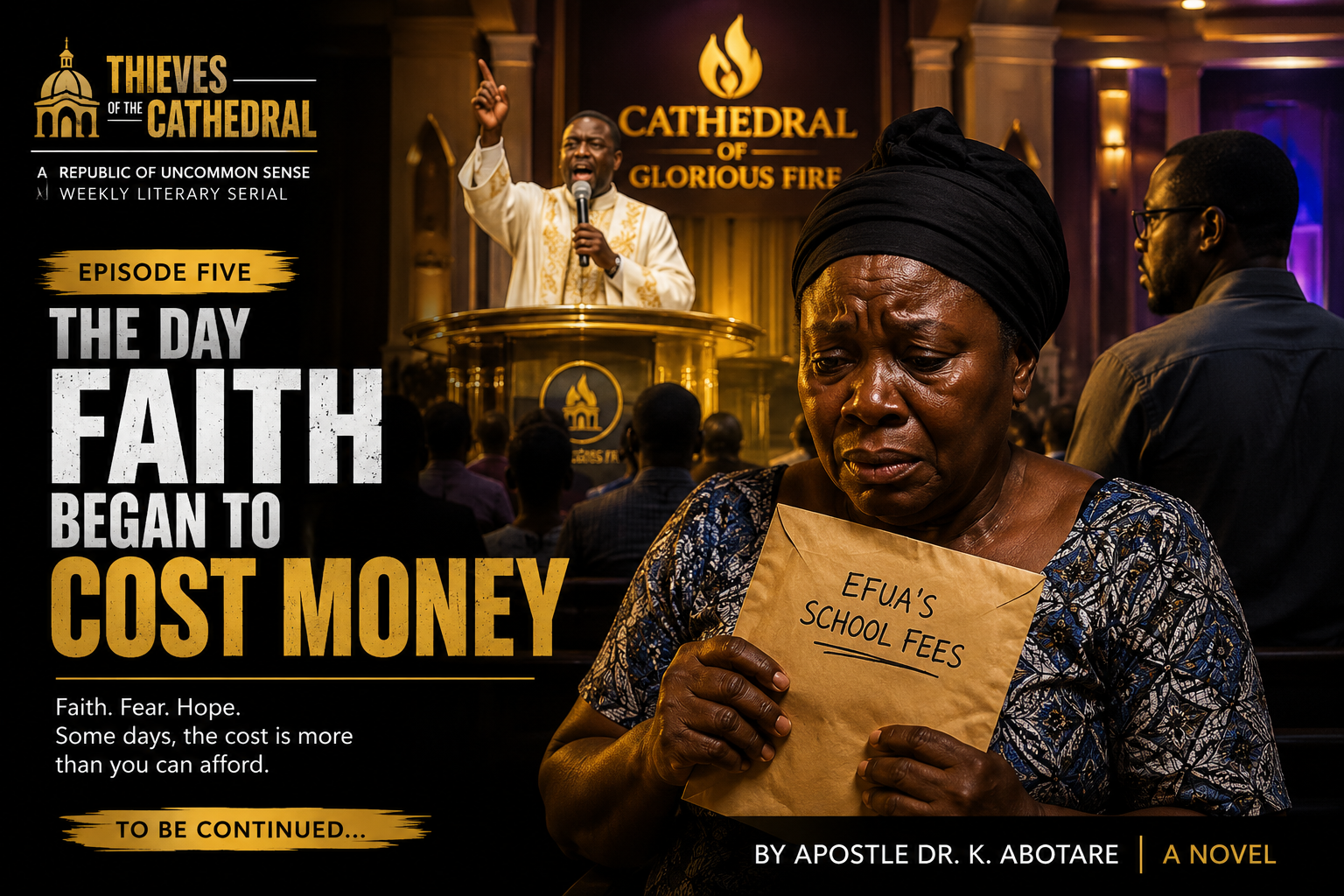
The Day Faith Began to Cost Money
By sunset, Mama Grace would lose the money meant for her daughter’s school fees. The strange thing was that nobody would steal it from her.
The Day Faith Began to Cost Money marks the beginning of Chapter One of Thieves of the Cathedral. As Mama Grace struggles to secure her daughter Efua’s future, an ordinary church service slowly becomes the stage for an extraordinary moral test. Meanwhile, Kojo Mensah watches from the back of the Cathedral, increasingly convinced that the movement’s greatest influence lies not in miracles, but in the stories it teaches people to believe.
By sunset, Mama Grace would lose the money meant for her daughter’s school fees, and the strange thing was that nobody would steal it from her. She would walk to the front of the church with her own feet, hold the envelope with her own hands, and place it in a brass bowl as though she were rescuing her future from drowning. Later, when hunger entered her house quietly and sat beside her only child, she would still call what she had done obedience. In Adomkrom, faith did not always arrive wearing white; sometimes it came dressed like pressure and spoke with the voice of a man who knew exactly when to lower his tone.
That morning, the market had woken before sunrise, as markets often do when poverty had trained people to treat punctuality like survival itself. Women arranged tomatoes in red pyramids, fishmongers argued with flies, and onion sellers sat behind their goods with the solemn patience of judges waiting for accused persons to confess voluntarily. Mama Grace moved through the noise with a basket on her arm and a calculation in her head. The school had warned her twice already, and the headmaster, who carried the permanent expression of a man disappointed by parents in general, had finally said the girl would be sent home if the balance remained unpaid by Monday.
She had folded the money into a handkerchief and tied it twice. A woman who ties money twice is not being dramatic; she is informing temptation that this particular money already has witnesses. Every few minutes, Mama Grace’s fingers returned to the knot as though school fees could evaporate through cloth. She bought only what was necessary: a small bowl of pepper, three fingers of plantain, and smoked fish so thin it looked as though disappointment itself had reached the fire before the fish did. Even the tomatoes seemed to stare back at her accusingly, as though inflation had finally developed personality.
As she paused beside a vegetable stall, her thoughts drifted briefly to Efua. The girl had spent part of the previous evening bent over an exercise book beneath the weak light of a rechargeable lamp, her tongue pressed lightly against her lip in concentration as she worked through mathematics problems. At one point she had looked up and announced confidently that she wanted to become a nurse one day because nurses helped people without waiting for politicians to organize a committee first. Mama Grace had laughed then, but the memory lingered now. Dreams, she had discovered, were often far more expensive than the people dreaming them understood.
Near the cassava stall, two women discussed Apostle Dr. B.K. Abotare of the Cathedral of Glorious Fire with the seriousness usually reserved for doctors and politicians during election season. One claimed her nephew had received a job interview after sowing what the church called a Destiny Seed. The other insisted her landlord stopped threatening eviction after the Apostle prayed over a bottle of anointing oil. Mama Grace did not join the conversation, but she slowed down the way people slow down near gossip they insist they are not listening to. In Adomkrom, information rarely arrived formally. Most of the time, it travelled through another person’s mouth disguised as ordinary conversation.
By noon, the town had already begun preparing itself emotionally for the evening service. Posters of Apostle Abotare hung from kiosks, electric poles, compound walls, and one tired mango tree near the taxi rank. His face carried a calm smile, the kind suggesting he knew secrets heaven had not yet released publicly.
Beneath it, bold letters announced:
BREAKING THE CURSE OF DELAY
ONE NIGHT OF PROPHETIC RELEASE
The word “free” appeared nowhere on the poster, which was wise because in matters of prophecy, free things often developed costs at the point of breakthrough.
Kojo Mensah saw the poster while returning from the printing shop. He stopped, read it twice, and smiled without joy. Kojo possessed the unfortunate habit of noticing patterns before they fully became problems, a quality that made him unpopular among people who preferred excitement to evidence. He taught literature at the senior high school and believed words behaved very much like cutlasses: useful in the hands of farmers, dangerous in the hands of drunk men.
Kojo’s concern was not that the man quoted scripture because many people quoted scripture. What bothered him was the neatness with which every sermon eventually found its way toward an offering bowl. The route changed. The destination never seemed to. Kojo had also noticed something else over time. The Cathedral rarely advertised salvation. It advertised outcomes. Jobs. Marriages. Visas. Breakthroughs. Deliverance from delay. Heaven, it seemed, had acquired a marketing department.
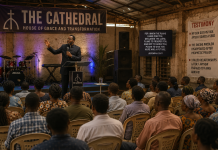
By six in the evening, the Cathedral of Glorious Fire was already full. The building, once an abandoned warehouse, still carried faint traces of dust, heat, and its former emptiness beneath the perfume, sweat, worship music, and anointing oil now saturating the auditorium nightly. Plastic chairs stretched from the pulpit to the entrance while latecomers stood along the walls with the humility of people who had arrived after grace completed its seating arrangements. The choir sang with great seriousness, assisted by a keyboard that sounded as though it had survived several spiritual wars. Every chorus climbed higher than the previous one until even doubt itself seemed forced to stand aside respectfully for the volume.
Mama Grace found a seat near the middle, close enough to see the pulpit clearly but far enough to avoid being called forward unexpectedly. She placed her basket beneath the chair and rested one hand carefully over the knot hidden inside her cloth. Beside her sat Yaw Boateng, a spare-parts dealer whose business had been shrinking beneath debts like a shirt washed too many times. Yaw’s wife had warned him repeatedly not to return home with another bottle of anointed sobolo, another wristband, or another prophetic instruction involving money. Desperation, however, rarely listened carefully because wisdom usually arrived only after damage had completed its work.
When Apostle Dr. B.K. Abotare finally entered, he did not rush, wave dramatically, or shout into the microphone. He walked slowly with a Bible in one hand and a white handkerchief in the other, as though the room had been waiting not for a man but for permission to breathe. His suit was dark, his shoes polished, and his face carried the calm composure of somebody entirely comfortable around other people’s emotional wounds. He did not look like a thief, and that was part of his power. Loud deceivers warn careful people immediately; calm ones invite people to remove their sandals and enter willingly.
He stood behind the pulpit and allowed the singing to fade naturally. Lesser preachers fought aggressively for silence, but Abotare understood something more sophisticated than performance. People surrender more willingly when they believe the silence belongs to them. When the final keyboard note dissolved into the room, he opened the Bible slowly with the tenderness of a surgeon uncovering an instrument.
“Beloved,” he said quietly, his voice low enough to make people lean forward instinctively, “poverty is not always lack of money. Sometimes poverty is a spiritual argument over your destiny.”
A murmur passed through the church. It was the kind of sentence explaining nothing clearly while touching many private wounds simultaneously. Mama Grace adjusted her headscarf slowly. Yaw lowered his eyes. Kojo, seated near the back with folded arms, watched the congregation respond the way dry grass responds to a small match dropped carelessly during harmattan.
Abotare read from Malachi with careful emphasis.
“Bring ye all the tithes into the storehouse, that there may be meat in mine house, and prove me now herewith, saith the Lord of hosts, if I will not open you the windows of heaven, and pour you out a blessing, that there shall not be room enough to receive it.”— Malachi 3:10
He closed the Bible gently but kept one finger between the pages as though heaven might require quick reference.
“God says prove me,” he continued calmly. “Not cry to me. Not explain to me. Not negotiate with me. Prove me. And how do you prove God? You release what your fear is holding.”
The church grew still because the sentence sounded true, and that was always the dangerous part. Lies arriving dressed foolishly can usually be chased away with laughter, but half-truths wrapped carefully in scripture often sit comfortably in the front row and get called Reverend.
Abotare stepped away from the pulpit and moved closer toward the congregation. He did not accuse them. He pitied them instead, and pity could enter places rebuke never reached successfully. He spoke about delayed marriages, unpaid fees, locked wombs, collapsing businesses, sick children, and job applications disappearing mysteriously like goats during Christmas season. With every example, somebody inside the church felt seen. With every pause, somebody else supplied the missing fear silently from their own private life.
Then Abotare lowered his voice further.
“There is somebody here,” he said, “whose miracle has been waiting for one act of dangerous obedience.”
The atmosphere tightened almost immediately as people searched themselves inwardly at once, even though Abotare had mentioned no names and offered no direct instruction beyond the quiet suggestion already spreading across the room. That was another part of Abotare’s brilliance. Vague prophecy often became powerful because listeners completed it privately using their own desperation.
The ushers moved slowly through the aisles carrying brass offering bowls polished brightly beneath the sanctuary lights. Soft music drifted back into the room while worshippers bowed their heads with varying degrees of sincerity, exhaustion, and calculation. Mama Grace felt her fingers tighten around the knot inside her cloth.
Thoughts of school fees, Monday morning, Efua’s face, and the headmaster’s warning pressed heavily against her mind just as Abotare began speaking again in the calm, measured tone that always seemed to make the congregation lean forward instinctively.
“Some sacrifices do not leave your hand,” he said softly. “They leave your future.”
Mama Grace closed her eyes.
Near the back, Kojo stopped watching the altar and began watching the congregation instead. What troubled Kojo was not merely the sermon itself but the visible relief spreading across people’s faces. The Cathedral gave suffering structure. It converted random disappointment into spiritual narrative, and human beings endured pain more easily once somebody explained it convincingly.
That realization disturbed him far more than shouting miracles ever could.
At the front, worshippers had already started rising one after another, carrying envelopes toward the altar while the choir sang softly about surrender and breakthrough. Some moved immediately with practiced certainty, while others remained seated for a few extra seconds wrestling privately with calculations only desperation fully understood before eventually standing as well.
Mama Grace held the envelope tightly against her chest while, somewhere beneath the worship music, a quieter fear had already begun asking whether heaven could still recognize people who kept saying no.
The school fees remained where she had hidden them. For now.
To Be Continued…
Next Week: Episode Six
The consequences of one night’s obedience begin to unfold, as the cost of faith becomes painfully real.
Join the Conversation
Mama Grace believes she is obeying God. Kojo believes something else is happening entirely. At what point does faith become pressure? Share your thoughts in the comments below.
Catch Up on the Story
If you’re new to the series, begin with Episode One: Before the First Amen, then journey through each weekly instalment of Thieves of the Cathedral.
Read the Complete Novel
Can’t wait for the next episode?
Thieves of the Cathedral is available worldwide in Kindle, Paperback and Hardcover on Amazon.
About the Author
Jimmy Aglah is a Ghanaian broadcaster, author and social commentator whose fiction explores faith, power, culture and the moral dilemmas that shape ordinary lives.