





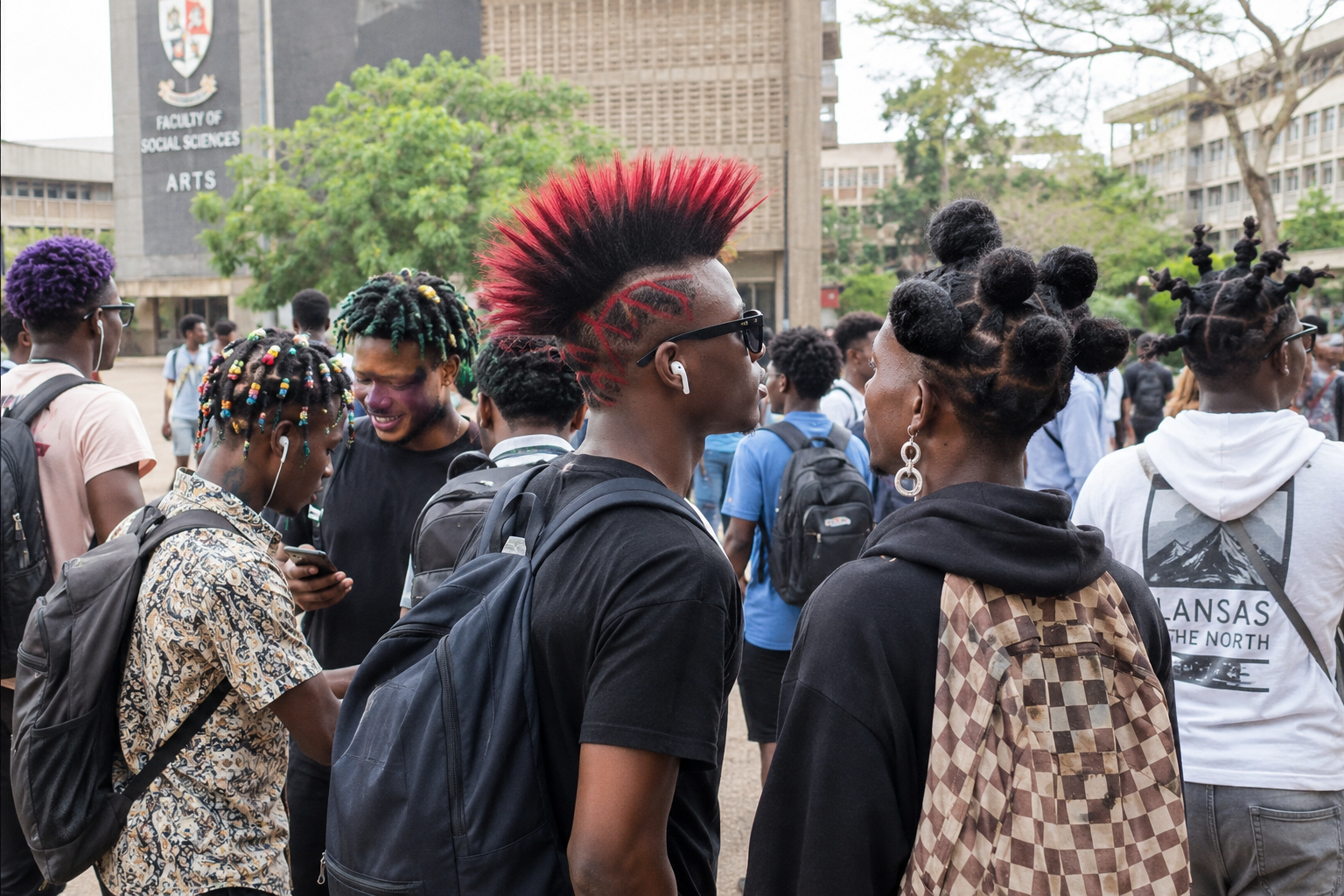
The University Hairstyles Debate has once again reminded us that we live in the Republic of Uncommon Sense. Once upon a time in this Republic, I made the innocent mistake of believing that universities existed to produce engineers, doctors, geologists, accountants and scientists. It was an understandable mistake, one that many of us have lived with for years without anybody bothering to correct us. We imagined that the future of higher education depended on lecture theatres, competent lecturers, well-equipped laboratories, current textbooks and students willing to burn the midnight candle. Little did we know that the fate of our universities had quietly migrated to the barber’s shop.
The University Hairstyles Debate has quickly become one of Ghana’s most talked-about conversations, attracting opinions from educators, parents, students and social commentators alike.
The University Hairstyles Debate
This debate has generated passionate opinions across Ghana, with supporters and critics offering compelling arguments.
The revelation came upon the Republic with all the drama of a divine visitation. One morning the nation was discussing the usual matters—graduate unemployment, the quality of education, research, innovation and the eternal complaint that too many certificates seemed unable to perform the work they certified. By sunset, however, all those complicated issues had been generously swept aside. The Republic had stumbled upon a discovery so profound that future historians would probably rank it alongside the invention of fire and the discovery of cocoa.
The real problem, we were made to understand, had been hiding in plain sight all along.
Hair.
Not inadequate laboratories.
Not overcrowded lecture halls where students often compete with broken microphones rather than ideas.
Not libraries whose newest books have become old enough to contest district assembly elections.
Hair.
And, for good measure, earrings.
Now, one of the things I have always admired about the Republic is its admirable efficiency whenever it discovers the wrong problem. Give us the wrong diagnosis and we shall produce the fastest cure in human history. Before anyone could ask whether braided hair had ever failed an examination in Differential Equations or whether dreadlocks had previously been arrested for poor performance in Organic Chemistry, the debate had spread from university campuses to radio studios, television panels, church pulpits, barbering salons and, naturally, the Republic’s largest parliament—the comment section.
Experts emerged from every imaginable direction. Those with educational backgrounds explained that universities existed not merely to fill young minds with knowledge but to shape character, discipline and responsible citizenship. Others, who required no educational qualifications beyond a smartphone and a generous data bundle, agreed with equal confidence. In the Republic, confidence has always enjoyed a higher market value than evidence.
What began as the University Hairstyles Debate was gradually becoming a much larger national conversation about discipline, freedom and character.
One elderly gentleman, whose spectacles looked almost as experienced as their owner, spoke with the quiet authority of someone who had watched Ghana pass through enough fashions to know that most of them eventually return wearing different names.
“My people,” he began, “let us not trivialise this matter. Education is not simply about passing examinations. It is about forming the whole person—the mind, the heart and the hands. Somewhere along the line we became so fascinated with academic performance that we quietly outsourced character formation to parents, churches and chance. Universities cannot become fashion runways and still expect to command the respect that scholarship deserves.”
There was something reassuring about the old man’s calmness. He was not shouting. He was not condemning anybody. He merely sounded like a grandfather wondering when common sense had quietly packed its bags and left the family compound.
Encouraged by the thoughtful silence that followed, he continued.
“I have entered lecture halls where some hairstyles arrive before their owners. I have seen perfumes conducting practical lessons of their own while lecturers struggled to teach thermodynamics. Surely, my brothers and sisters, seriousness must still have a place in serious institutions.”
A good number of heads nodded.
Even those who disagreed found themselves nodding politely.
Then, from somewhere near the back of the gathering, another gentleman rose with the caution of a man requesting permission to disagree with common sense itself.
“My only difficulty,” he said softly, “is that I have lived long enough to see some of the Republic’s greatest scandals organised by gentlemen whose shirts were perfectly ironed, whose ties were beautifully knotted and whose shoes reflected enough sunlight to inconvenience passing motorists. I have never heard a commission of inquiry conclude that public money disappeared because the suspect wore dreadlocks.”
The laughter that followed was not loud.
It was the uncomfortable kind.
The kind that arrives when truth unexpectedly borrows humour to enter a conversation.
He was not finished.
“I am merely asking,” he continued, “whether we are in danger of confusing appearance with character. A neatly folded sleeve has never successfully folded away dishonesty. Neither has a haircut ever frightened corruption into early retirement.”
That observation might well have ended the discussion had a young undergraduate not risen to offer what he described as a humble logistical concern.
“I have no quarrel with discipline,” he said. “I only request that before anybody insists on jackets and neckties in the name of academic excellence, they should kindly spend two uninterrupted hours inside one of our lecture halls.”
The audience laughed before he had even explained himself.
“We live in the tropics,” he continued. “Our lecturers leave air-conditioned offices, enter air-conditioned vehicles and return to air-conditioned homes. We, meanwhile, attend lectures in rooms where the ceiling fans appear to have entered into a secret non-aggression pact with the heat. By the end of a two-hour lecture, the only thing graduating with First Class Honours is perspiration.”
For reasons nobody adequately explained, even the ceiling fans seemed slightly embarrassed.
Anybody who imagined the debate would quietly end there clearly underestimated the Republic. Matters of hair have never respected institutional boundaries. Before long, rumour had it that Parliament was preparing to consider the Dangerous Hairstyles (Control and Prevention) Regulations, a legislative masterpiece designed to protect higher education from braids capable of distracting engineering students during lectures. Nobody could produce a copy of the Bill, but that did not inconvenience the discussion in the slightest. The Republic has always possessed remarkable confidence in explaining documents it has never read.
The churches, unwilling to be left behind in a matter of obvious national importance, soon announced revival services dedicated to spiritual warfare against rebellious hairstyles. Testimonies flowed with admirable enthusiasm. One young man declared that surrendering his braids had immediately improved his understanding of Organic Chemistry. Another reported miraculous deliverance from habitual lateness after removing a single earring. Only one elderly grandmother quietly asked whether the same haircut had also reduced university fees and hostel accommodation. According to reliable witnesses, her microphone chose that precise moment to develop a mysterious fault.
Employers watched these developments with understandable excitement. Recruitment interviews acquired an additional stage. Degrees remained important, references continued to matter, but somewhere between the handshake and the final interview, a hairstyle now seemed capable of determining leadership potential. One suspects that barbers across the Republic silently offered prayers of thanksgiving for this unexpected expansion of their professional influence.
Yet through all this admirable national determination to rescue morality from the barber’s chair, corruption remained astonishingly uncooperative. Contracts still wandered into unfamiliar pockets. Public money continued travelling without valid passports. Procurement irregularities behaved as though they had never received the official circular concerning hairstyles. It slowly dawned on the Republic that corruption had always displayed an unfortunate preference for expensive suits, polished shoes, flowing gowns and carefully rehearsed respectability. Hairstyles, it seemed, had never been among its preferred accomplices.
As the argument wandered from campuses to churches, from Parliament to barbering salons, an old retired headmaster who had listened more than he had spoken finally leaned upon his walking stick and smiled the smile of a man who had survived too many national debates to become excited by another.
“My children,” he said quietly, “perhaps both sides have been right in ways neither fully appreciates. A university without standards soon loses its dignity, but a nation that mistakes appearance for character may spend the rest of its life ironing shirts while leaving consciences permanently creased.”
Nobody rushed to applaud him.
Wisdom rarely enjoys immediate popularity.
People simply drifted away, each carrying home a different version of the argument. Some remained convinced that discipline begins with appearance. Others insisted that integrity has never lived inside a wardrobe. As for me, I walked away wondering whether the Republic would ever discover that the hardest things to cultivate are also the hardest things to inspect.
For there is an old Ghanaian truth that deserves admission into every university curriculum: the cleanliness of the calabash is not determined by how brightly its outside shines, but by what it carries within.
Perhaps the University Dress Code Debate was never really about hair alone. It has become a wider conversation about discipline, identity and character.
Unfortunately, in the Republic of Uncommon Sense, we have always been unusually impressed by polished calabashes.
The Republic of Uncommon Sense doesn’t end here…
If you enjoyed this article, you’ll probably enjoy my books too.

📚 Continue the journey. Explore Jimmy Aglah’s novels and satirical works on Amazon. Click the image above or visit:
https://amazon.com/author/jimmyaglah
Available worldwide on Amazon