



A Weekly Literary Serial by Jimmy Aglah
Episode 6
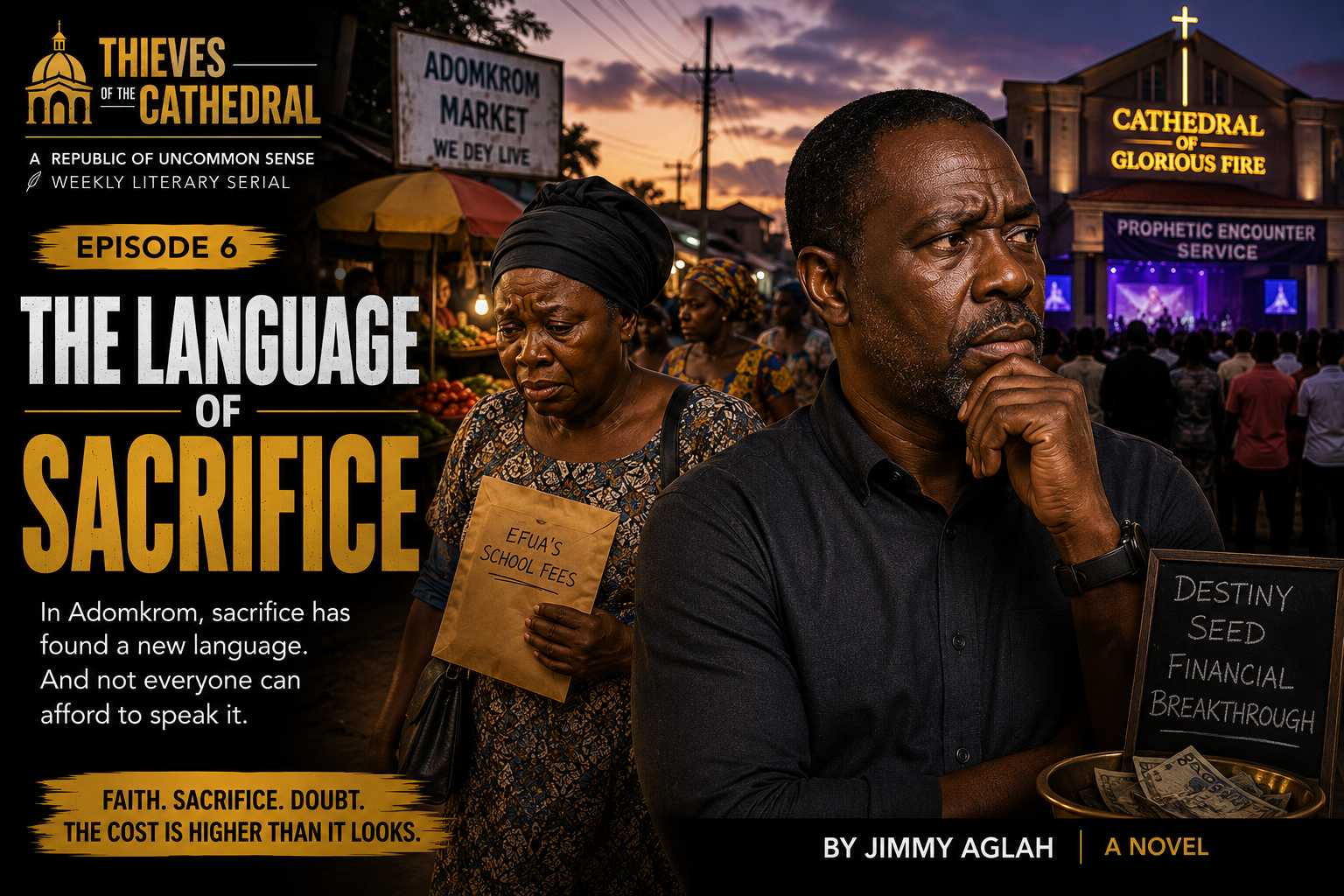
The Language of Sacrifice
Three people in Adomkrom are about to borrow money they cannot comfortably repay. None of them believes they are making a mistake.
Episode Introduction
The Language of Sacrifice explores what happens after extraordinary religious experiences become ordinary conversations. As Mama Grace struggles with mounting financial pressure, Kojo Mensah begins questioning not the sincerity of belief, but the subtle ways suffering can be transformed into spiritual obligation. Across Adomkrom, the Cathedral’s influence is no longer confined to Sunday services—it has quietly entered classrooms, market stalls and family conversations.
By the following Wednesday, three people in Adomkrom would borrow money they could not comfortably repay simply because Apostle Dr. B.K. Abotare had described sacrifice as the shortest road between delay and divine remembrance. None of them considered themselves foolish. In fact, each person involved would later explain the decision with the calm seriousness usually reserved for hospital emergencies and funeral contributions. That was how the Cathedral worked best. It did not drag people toward surrender violently. It persuaded them that surrender itself was wisdom wearing spiritual clothes.
Mama Grace spent most of that week avoiding the headmaster’s office.
Whenever she crossed the school compound to deliver food to Efua during break time, she moved carefully along the outer corridor as though disappointment itself might be waiting nearby carrying attendance sheets and unpaid balances. The headmaster had not repeated his warning after Monday passed without payment, but his politeness had grown heavier. Some forms of courtesy contained more pressure than insults.
Efua too had changed slightly.
Children notice financial strain long before adults realize it has become visible. The girl no longer asked openly about the fees. She simply returned home quieter than before and spent longer periods staring at her books with the concentration of somebody trying to study her way out of embarrassment.
One evening, Mama Grace found her carefully covering an old exercise book with brown paper salvaged from a used cement bag.
“We are supposed to use proper covers,” Efua explained softly. “But this one will still work.”
The girl smiled as though she were helping solve a family problem instead of quietly adapting to one.
That smile troubled Mama Grace more than any complaint could have.
On Thursday afternoon, while passing through the market on her way home, Mama Grace overheard two women discussing the previous service with the emotional excitement usually reserved for successful visa applications and miracle childbirth stories.
“That prophecy was direct,” one woman whispered while counting coins into a tin bowl. “The man of God said somebody’s sacrifice would remove a family curse before the month ended.”
The second woman nodded vigorously.
“These things are spiritual. You cannot calculate them with ordinary mind.”
Mama Grace slowed her pace slightly as she passed them, careful to keep her expression neutral even while listening closely. In places like Adomkrom, people often pretend indifference not because they lack interest, but because openly following conversations about hope can expose private desperation too easily.
Nearby, a woman selling smoked fish joined the discussion without invitation.
“I’m telling you,” she announced loudly, “that church is different. Since I started attending, even my sleep has changed.”
Another trader laughed.
“Sleep too has become breakthrough?”
The fish seller pointed at her with one oily finger.
“Mock if you want. Some people only respect miracles after suffering has collected rent from the whole household.”
The women around her laughed softly, though the laughter carried the uneasy caution common among people joking about problems that had already entered their own homes in one form or another.
The fish seller continued.
“And when my husband died last year, the Cathedral people brought food to my house for almost three weeks. Nobody asked whether I could pay. Nobody asked what church I attended before. Sometimes people talk as if everything there is about money. Some of us were helped when nobody else came.”
For a moment, nobody argued.
Even the sceptical trader merely shrugged and returned to arranging smoked herrings on a wooden tray.
In Adomkrom, humour often survived by disguising fears too familiar to confront directly for long, but gratitude had a way of silencing arguments temporarily.
Across town, Kojo Mensah sat beneath the neem tree behind the school compound watching students play football with the emotional seriousness usually reserved for constitutional elections. Dust rose behind them while teachers prepared slowly for closing time. One of the younger staff members approached carrying a bottle of malt and sat beside him.
“You’ve still not joined the Cathedral properly?” the younger teacher asked while turning the bottle slowly between his palms.
Kojo smiled faintly.
“Church membership is beginning to sound like mobile money registration these days.”
The younger man laughed before lowering his voice, partly from caution and partly because conversations about the Cathedral had started acquiring the same careful tone people usually reserved for politics and family scandals.
“But honestly, sir, people are seeing results there.”
Kojo watched the students chasing the football through rising dust before answering.
“Results and truth are not always twins.”
The younger teacher frowned slightly.
“So you don’t believe the testimonies?”
“That’s not the question troubling me,” Kojo replied, folding his arms loosely across his chest. “What worries me is how quickly suffering can make intelligent people surrender responsibility for their thinking.”
The younger teacher looked uncomfortable immediately, not because Kojo sounded disrespectful, but because the sentence brushed too closely against private fears many people preferred leaving untouched.
Kojo noticed the discomfort and decided not to continue. More and more often, he found himself abandoning such conversations halfway. The more popular the Cathedral became, the less comfortable people seemed discussing it honestly. Doubt had not become forbidden in Adomkrom yet, but it had started sounding unnecessarily unfriendly.
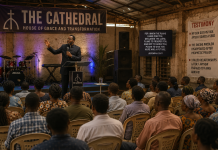
That evening, the Cathedral hosted what posters around town described as a Prophetic Encounter Service. By six-thirty, the compound overflowed with taxis, traders, office workers, students, unemployed graduates, and married women carrying emotional exhaustion beneath carefully ironed clothes.
Episode Reflection
The Cathedral’s influence is no longer confined to the altar. It has quietly entered classrooms, market stalls, staff common rooms and family conversations. As Kojo Mensah observes, ideas can travel farther than miracles, and beliefs can reshape a community long before anyone notices the change. In Adomkrom, another service is about to begin—but the real transformation may already be well underway.
To Be Continued…
Episode 7: Dangerous Obedience
A packed Cathedral. A carefully timed sermon. A congregation searching itself for hidden delays. Before the night is over, hesitation itself will begin to feel like disobedience.
Catch Up on the Story
Missed an episode?
- Episode 1 – Before the First Amen
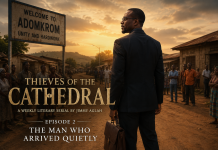
- Episode 2 – The Man Who Arrived Quietly
- Episode 3 – The Warehouse Became the Cathedral
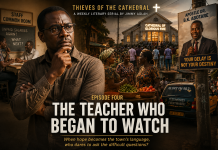
- Episode 4 – The Teacher Who Began to Watch
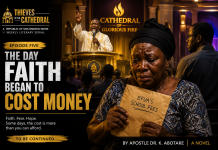
- Episode 5 – The Day Faith Began to Cost Money
Read the Complete Novel
Can’t wait for next week’s episode?
Continue reading after The Language of Sacrifice by purchasing the complete novel.
Thieves of the Cathedral is available worldwide in:
- Kindle
- Paperback
- Hardcover
About the Author
Jimmy Aglah is a Ghanaian media leader, author and social commentator whose fiction explores faith, power, leadership and the moral choices that shape ordinary lives. Thieves of the Cathedral is serialized weekly on Republic of Uncommon Sense.