





Once upon a time in the Republic of Uncommon Sense, death was regarded as the one event capable of ending every quarrel. It was believed that when a man finally departed this world, old grudges quietly folded their tents, wounded hearts found reasons to forgive, and those left behind gathered not to argue over yesterday but to honour a life that had enriched them all. It was a comforting belief, handed down from one generation to another. Then, as with many comforting beliefs, the Republic improved upon it.
Inheritance disputes in Ghana have become one of the Republic’s most predictable public spectacles…
Recent inheritance disputes in Ghana remind us that death no longer ends every disagreement. In the Republic, it often marks the beginning of another chapter.
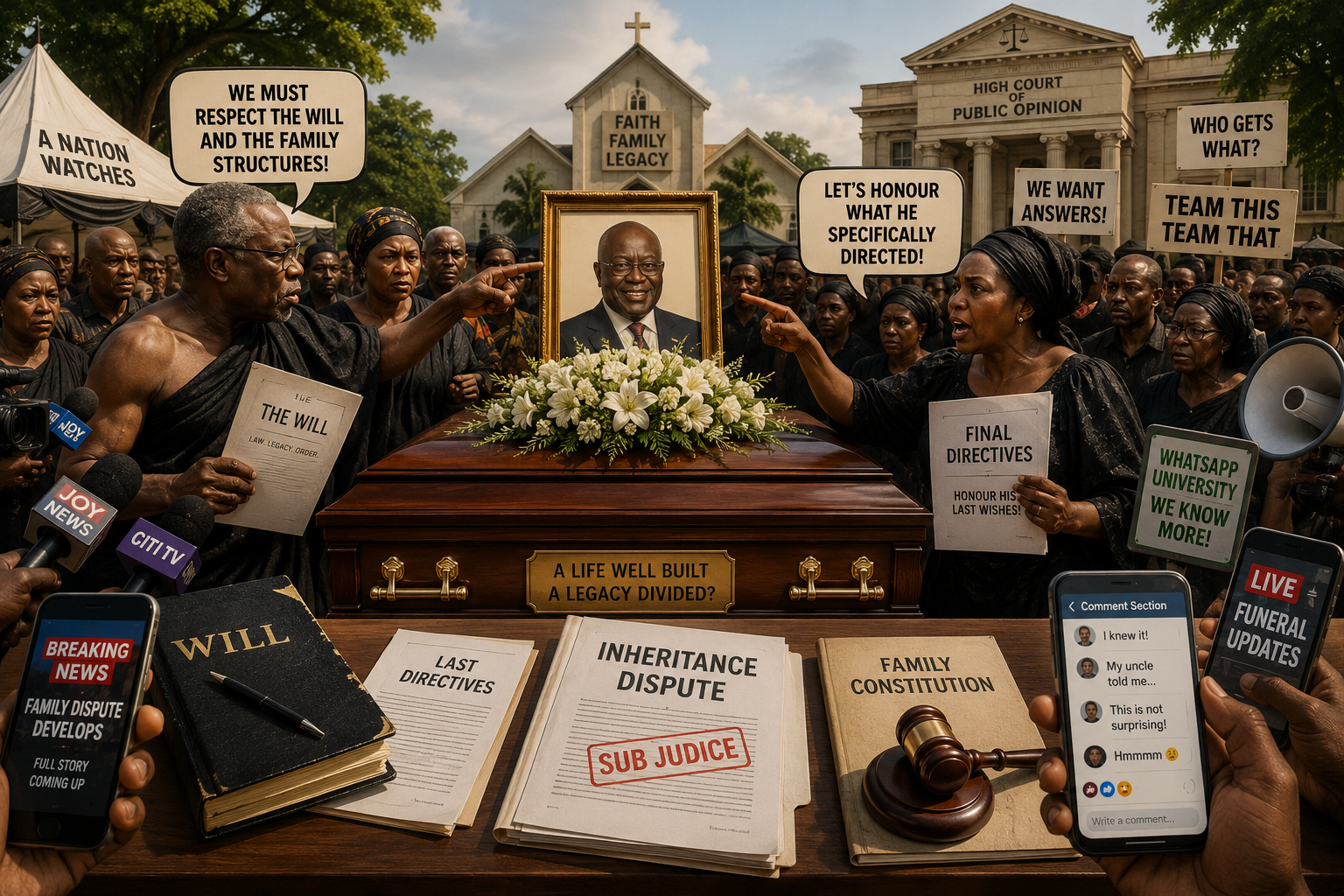
No sooner has the obituary been printed than the Republic springs into action with the efficiency of a well-drilled emergency response unit. Family meetings are convened. Emergency family meetings are held to discuss the outcome of the first family meeting. Lawyers rediscover long-forgotten clauses. Elders dust off traditions that had been sleeping peacefully for decades. Radio stations rearrange their morning programmes. Television panels suddenly become seminars in inheritance law. Before the funeral hymn has been chosen, the Comment Section has already delivered its final judgment.

The late Apostle Kwadwo Safo has become the Republic’s latest classroom.
Not because of the remarkable machines he built or the institutions he established, but because his departure has once again reminded us that in the Republic, funerals are rarely about the departed alone. They are examinations in which the living answer questions the deceased never set.
Why Inheritance Disputes in Ghana Become National Spectacles
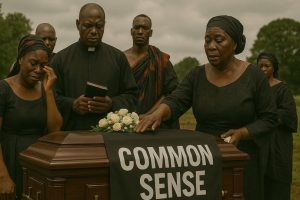
Readers of the Republic may recall that we once mourned the passing of something even more elusive in The Funeral of Common Sense. Sadly, it appears that Common Sense is still missing from many of the funerals attended by the living.
At the heart of the present story stand two siblings, Nana Kwadwo Safo Akofena and Sarah Adwoa Safo. Each has publicly maintained that the greatest duty owed to their late father is fidelity to his wishes. One insists that the will and the structures surrounding the family must be respected. The other maintains with equal conviction that the Apostle’s final directives should be honoured exactly as he intended. Between those two positions lie a funeral, a family, a church, a remarkable legacy and a nation that has suddenly developed an advanced interest in probate law.
That, perhaps, is the Republic’s first and greatest irony. The public positions of the two siblings are strikingly similar, even as they lead them in opposite directions. Neither presents himself or herself as an adversary of their late father. On the contrary, each speaks the language of loyalty, each invokes love, and each insists that the surest way to honour Apostle Kwadwo Safo is to remain faithful to what the late Apostle intended in his final directives.
It is this shared profession of devotion that makes the disagreement so compelling, for when two people are convinced that they are defending the same legacy, the conflict is no longer merely about inheritance. It becomes a contest over memory, duty and the meaning of a father’s final voice. The only gentleman capable of confirming whose interpretation is correct has politely excused himself from further earthly interviews.
An old Ghanaian proverb reminds us that when brothers fight over a farm, the weeds celebrate. The Republic has modernised that wisdom. When prominent families disagree, the weeds are joined by television studios, WhatsApp groups, Facebook Live sessions and thousands of amateur constitutional scholars who, until last Tuesday, had never shown the slightest curiosity about wills, executors or succession law.
The Republic possesses an extraordinary gift for producing experts at breathtaking speed. A single press statement is enough to transform a barber into a legal analyst, a taxi driver into a historian of family custom and an office clerk into a leading authority on church constitutions. Those genuinely curious about how wills are actually governed may find Ghana’s Wills Act, 1971 (Act 360) rather less dramatic than the Comment Section, but considerably more authoritative. Somewhere between breakfast and lunch, confidential family conversations become public property, anonymous sources become national treasures and rumours acquire the status of sacred texts.
The busiest courtroom in the Republic, after all, has never been built with bricks and mortar.
It is called the Comment Section.
Its judges require no legal training. Their robes are woven from confidence, their gavels are smartphones and their evidence consists largely of voice notes beginning with the immortal declaration: “My brother knows somebody very close to the family.”
Appeals are unnecessary because every verdict is delivered with complete certainty.
One cannot help smiling at the Republic’s remarkable optimism. We struggle to agree on the correct score of a football match watched by millions, yet we confidently explain the private intentions of a departed man whose final conversations were heard by only a handful of people.
There is, however, a quieter story beneath all the noise.
Every inheritance dispute has two inventories.
Many of the most public inheritance disputes in Ghana follow this familiar pattern, where arguments over property gradually eclipse relationships.
The first is visible. It contains land, houses, factories, vehicles, investments and bank accounts. Those are the assets newspapers report and lawyers catalogue.
The second inventory is almost never mentioned. It contains trust, childhood memories, shared laughter, mutual respect, family affection and the invisible threads that enable brothers and sisters to remain family long after their parents have departed.
The first inventory is measured in money.
The second is measured in relationships.
The tragedy is that families often spend years protecting the first while quietly exhausting the second.
Perhaps that is why the present dispute has stirred emotions far beyond the Kristo Asafo family. Many Ghanaians are not merely watching a disagreement over succession. They are seeing reflections of conversations that have unfolded around countless dining tables after the passing of fathers and mothers whose greatest wish was surely not that their children should become strangers.
Property can be divided by surveyors.
Love cannot.
Factories can be valued by accountants.
Trust cannot.
A courtroom may eventually determine who possesses legal authority over a particular asset, but no judgment can compel wounded hearts to become whole again.
That may well be the costliest inheritance of all.
The irony becomes even more striking when one remembers the life of Apostle Kwadwo Safo himself. Here was a man who devoted decades to building. He built machines that many believed could not be built locally. He established institutions where others saw only obstacles. He encouraged generations of Ghanaians to believe that ingenuity, discipline and persistence could transform ideas into reality.
Builders leave behind more than buildings.
They leave blueprints.
A blueprint, however, is useful only when those who inherit it agree that constructing the future is more important than disputing the ownership of the tools.
Perhaps that is the Republic’s enduring lesson.
We have become exceptionally skilled at inheriting the products of greatness while paying less attention to the principles that produced that greatness in the first place. We admire the factory more than the discipline that built it, celebrate the estate more enthusiastically than the values that sustained it and sometimes become so absorbed in dividing yesterday that we forget to build tomorrow.
This is not the story of one family alone.
It is the story of a Republic that repeatedly discovers how difficult it is to preserve unity after applauding success.
Somewhere beyond the court filings, beyond the microphones, beyond the competing statements and beyond the endless verdicts of the Comment Section, one imagines an old inventor contemplating the most complicated machine ever associated with his name. It is not an automobile, an aircraft or a factory assembly line. It is the delicate machinery of family, legacy and memory, where no spanner can tighten trust and no engine can manufacture reconciliation.
Until someone invents such a machine, the Republic will continue doing what it has always done with remarkable enthusiasm. We shall organise magnificent funerals, deliver magnificent tributes, issue magnificent statements and, in the process, remind ourselves that although death comes to everyone, not every Republic buries its dead in quite the same way.
For ours, as always, remains the Republic Where Everybody Buries the Dead Differently.